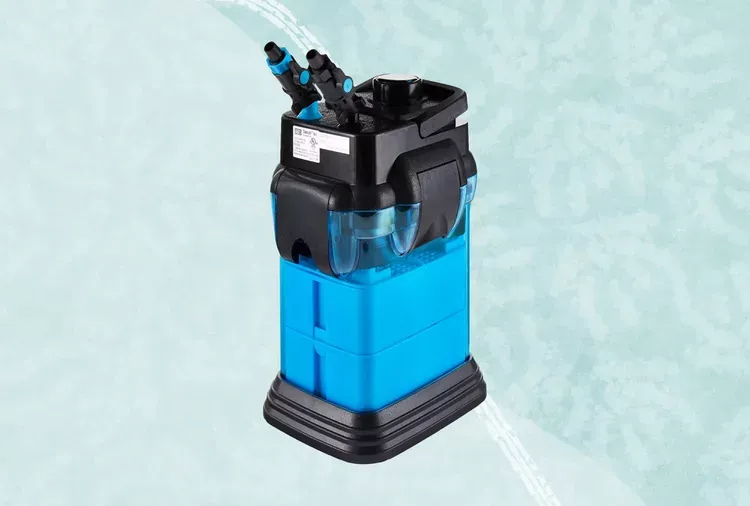
Here’s the short version, because most axolotl filter guides bury it: for the average keeper, the best filter is a big sponge filter run off an air pump. Cheap, quiet, gentle flow, strong biological filtration, and no intake that can grab a gill. If you’re on a larger tank or you want mechanical polishing too, a canister filter with the output baffled down is the other solid answer.
Axolotls make the filter question harder than it is for tropical fish, and it comes down to one tension. They have a heavy bioload, meaning they pump out a lot of ammonia, and they absorb that ammonia right across their skin and those external gills. So you need real biological filtration. But they also hate current. Strong flow stresses them and makes their gill filaments curl forward, which is the animal telling you the water’s moving too much. So the filter has to do heavy biological work while barely disturbing the water the axolotl sits in. That tension is the whole design problem, and every recommendation below is aimed at it.
One thing to get out of the way: skip under-gravel and substrate filters entirely. They pull waste down into the substrate an axolotl may swallow, and axolotls do best on bare-bottom or fine sand anyway because of impaction risk. An under-gravel filter fights both of those.
Quick picks
- Best overall for most keepers: large air-driven sponge filter. Buy one rated well above your tank size and pair it with a decent air pump.
- Best powered/canister pick: Penn-Plax Cascade Canister Filter 500. Quiet, easy to prime, and the whole Cascade line has a flow-control valve plus a spray bar, which is exactly what you want for an axolotl.
- Best budget canister for nano/small setups: Zoo Med Nano 30 External Canister Filter. Compact, inexpensive, fine for a small juvenile or hospital tank.
- Best for a larger axolotl tank: Aqueon QuietFlow Canister Filter. More capacity, quiet, just plan to baffle the return.
- Don’t forget: a pre-filter intake sponge for any canister or HOB. This is a safety item, not a nicety.
Comparison table
| Filter | Type | Good for tank size | Flow / turnover | Axolotl notes | Price |
|---|---|---|---|---|---|
| Large air-driven sponge filter | Sponge (air pump) | Up to ~40 gal per unit | Gentle, diffuse; set by air pump | Safest default; no intake hazard, silent | $ |
| Penn-Plax Cascade 500 | Canister | 30 gal and under | ~115 GPH, flow valve + spray bar | Baffle the return; my top powered pick | $$ |
| Zoo Med Nano 30 | Canister | Up to ~30 gal | ~79 GPH rated | Low flow already; great budget nano pick | $ |
| Aqueon QuietFlow | Canister | 40 to 55 gal | ~155 to 200 GPH depending on model | Strong; needs baffling for a lotl | $$$ |
| Fluval 207 (search) | Canister | Up to ~45 gal | ~206 GPH | Low-end canister flow, fine when baffled | $$$ |
| Penn-Plax Cascade (larger) | Canister | 50 to 100 gal | Flow valve on every size | Valve makes throttling easy | $$ to $$$ |
| Pre-filter intake sponge | Accessory | Any | n/a | Required over any bare intake | $ |
What “axolotl filtration” actually means
If you’re new to this, filtration on an axolotl tank is doing three jobs. Mechanical filtration traps floating gunk (poop, uneaten food, shed skin). Biological filtration is the important one: it’s the colony of nitrifying bacteria living on your media that convert ammonia into nitrite and then into far-less-toxic nitrate. Chemical filtration, usually activated carbon, pulls dissolved junk and odors and is the least essential of the three.
For an axolotl, biological filtration is the part you can’t skimp on. These animals are ammonia factories, and because they take up gases and ions through their skin and gills, even low ammonia readings that a hardy fish would shrug off can burn an axolotl. That’s why the filter and the nitrogen cycle are really the same conversation. A filter without an established bacterial colony is just a water pump. You need the tank fully cycled before the axolotl ever goes in. If “cycling” is a fuzzy term to you, read the complete guide to aquarium cycling and the nitrogen cycle first, then come back and pick a filter.
So when people search “do axolotls need a filter,” the practical answer is: you need biological filtration and stable water. A filter is by far the easiest way to get both. Going filterless is possible but means committing to daily testing and frequent water changes forever, and one missed day can spike ammonia.
Sponge filters: the default best choice
I lead with sponge filters because for the majority of axolotl keepers they’re simply the right tool, and they’re the pick most experienced lotl people land on. Here’s why they fit the animal so well.
An air-driven sponge filter works by bubbling air up through a tube, which pulls water through a big block of foam. That foam is enormous biological surface area, so the bacterial colony gets huge. The flow it produces is slow and diffuse, nothing like a pump jet. There’s no impeller intake, so there’s nothing that can suck in a gill filament or a tiny limb. It’s close to silent, the running cost is just an air pump, and cleaning is “squeeze the sponge in a bucket of old tank water.” For an animal that needs a big bacterial colony but panics in current, that combination is hard to beat.
The one rule: oversize it. Buy a sponge filter rated well above your tank. On a 20 to 40 gallon axolotl tank, grab one rated for 60 to 75+ gallons. The bigger the sponge, the more bacteria it holds and the more slowly it clogs. Sit it in a back corner. If your tank is on the larger side, run two sponge filters in opposite corners rather than one giant unit; it spreads the biofiltration and gives you a backup if one clogs.
A sponge filter is only as good as the air pump driving it, and this is where people cheap out and end up with a buzzing pump on the nightstand. Match the pump to the sponge and the tank depth. I’ve written up quiet pumps in detail in the best aquarium air pumps guide; the same picks that keep a betta setup silent will run an axolotl sponge filter beautifully.
Key features: massive biological surface area, gentle diffuse flow, no dangerous intake, near-silent, pennies to run, dead-simple to clean. My pick: a large air-driven sponge filter rated for a bigger tank than you actually have. The BactoSurge and similar coarse-foam models are the ones I’d look at first.
Downside: sponge filters do nothing for water clarity beyond biological work, so if you want crystal, particle-free water you’ll want a canister or HOB alongside (or instead). And the rising column of bubbles isn’t to everyone’s taste visually.
Canister filters: great, if you tame the flow
Canisters sit under the tank in the cabinet and push water through stacked trays of media, so you get lots of room for mechanical, biological, and chemical stages. On a bigger axolotl tank, or if you want polished water, a canister is a strong choice. The catch is that canisters move a lot of water, and out of the box that flow is too strong for an axolotl. You fix that by choosing a lower-flow model and baffling the output, which I cover in the next section.
Look for canisters with a flow-control valve and a spray bar. The Penn-Plax Cascade line has both on every size, which is the main reason I keep recommending it for this animal. The Fluval 207 is another one worth considering: it’s a well-built canister that only pushes around 206 GPH, low for a canister, so it’s easier to bring into axolotl territory once baffled.
A note on canisters and temperature. Axolotls are cool-water animals. They’re happiest around 60 to 68F (16 to 20C) and get stressed above roughly 74F. A canister motor can add a touch of heat to the water, which is nothing in a cool room but matters in a warm one. If your house runs hot in summer, watch your thermometer, and know that a fan or a chiller may be needed regardless of filter. I go through cooling options in the aquarium chillers guide for hot climates.
Penn-Plax Cascade Canister Filter 500
This is my top powered pick for small to mid axolotl tanks. It’s an external canister with two stackable media trays (coarse sponge and activated carbon included) that are genuinely easy to pull and rebuild, so maintenance isn’t a wrestling match. The push-button primer means you don’t have to mouth-siphon to get it going, and the two independent valve taps rotate a full 360 degrees so you can route hoses into a tight cabinet without kinks. It runs quiet, just a faint motor hum.
For an axolotl, the important bit is the flow-control valve plus the included spray bar. Set the valve down, run the spray bar along the back glass, and you turn a capable canister into a gentle one. Rated flow is about 115 GPH, which suits tanks 30 gallons and under nicely once dialed back.
Key features: ~115 GPH with an adjustable flow valve, spray bar included, push-button primer, 360-degree rotating valve taps, two stackable media trays (coarse sponge and activated carbon included), quiet motor. Dimensions about 11.5 x 9 x 13.5 inches.
Zoo Med Nano 30 External Canister Filter
The budget canister, and a smart one for small setups: a juvenile axolotl in a grow-out tank, a hospital or quarantine tank, or a small 20-long. It’s a compact external canister rated for tanks up to about 30 gallons at roughly 79 GPH, which is already gentle by canister standards, so you have less baffling to do. It ships with mechanical, chemical, and biological media and the housing is small enough to tuck almost anywhere.
It’s not going to filter a 40-gallon breeder on its own, and the media trays are modest, so don’t ask it to do more than its size. Within its range it’s good value and an easy first canister.
Key features: ~79 GPH, rated to ~30 gallons, compact external body, three-stage media included, low price. Best for small or secondary tanks.
Aqueon QuietFlow Canister Filter
Step up to this for a larger axolotl tank in the 40 to 55 gallon range. It’s a multi-stage canister with a self-priming button (hold it a few seconds, it fills itself) and it does run quietly for the water volume it moves. You get the mechanical, chemical, and biological stages, plus a water-polishing cartridge that catches fine particles.
Two caveats. That polishing cartridge is a monthly replacement, so factor the ongoing cost. And this pushes more water than the Cascade 500, somewhere around 155 to 200 GPH depending on the model, so baffling the return isn’t optional here, it’s the job. Spray bar along the glass or a sponge over the nozzle, and check your axolotl’s gills aren’t curling.
Key features: multi-stage filtration, self-priming, quiet for its size, water-polishing cartridge, higher capacity for bigger tanks. Plan on baffling the output.
Fluval 207 (a strong option, no verified link)
I don’t have a direct link I trust for this one, so search it rather than trusting a random listing, but the Fluval 207 deserves a mention. It’s rated for tanks up to about 45 gallons and only moves around 206 GPH, which is genuinely low for a canister and makes it easier to bring into gentle-flow territory. Build quality is a step above the budget options, priming is easy, and the media baskets are roomy. If you want a canister that’s closer to axolotl-friendly before you even baffle it, this is the one to compare against the Cascade line. Find the current listing here: Fluval 207 on Amazon.
Hang-on-back (HOB) filters: fine with two fixes
HOB filters hang off the back rim and are the cheapest, simplest powered option. They work for axolotls, but only if you do two things. First, pick one with adjustable flow, or plan to baffle it, because the waterfall return is too much current straight out of the box. Second, and this is the one people forget, cover the intake with a pre-filter sponge. A bare HOB intake is a suction hazard for gills and limbs.
The classic HOB choices are the AquaClear line, which has a big media basket and a flow dial, and the MarineLand Penguin, which uses a bio-wheel for extra biological surface. Both are fine for a lotl once you disperse the output. If you’d rather dig into power filters specifically before deciding between canister and HOB, I compared them in more depth in the best aquarium power filters guide.
Key features to want in a HOB for axolotls: adjustable flow rate, generous media basket, and compatibility with a pre-filter intake sponge. Browse current options: adjustable-flow HOB filters on Amazon.
Low flow, turnover math, and why GPH alone lies
You’ll see a lot of guides hand you a single magic number (“100 GPH, never more”). That’s not quite right, and it can steer you wrong in both directions.
Start with turnover, which is how many times your filter cycles the whole tank volume per hour. A sensible starting range for axolotls is 4 to 6 times per hour. So a 40-gallon tank wants somewhere around 160 to 240 GPH of filtration as a baseline. Simple enough.
But here’s the part the single-number rule misses: a stronger filter is fine if the flow is dispersed. You can run a filter at 8 to 10x turnover safely if the output is baffled so the water spreads out gently instead of jetting into one spot. The thing that hurts an axolotl isn’t the number on the box, it’s the velocity of water where the animal actually sits. A 300 GPH canister with a spray bar aimed along the back glass can be calmer at axolotl level than a 120 GPH HOB dumping a single hard stream into open water.
So use turnover to get in the right ballpark, then let your axolotl grade you. Gill filaments (the fimbriae) that curl forward, an animal that’s constantly getting pushed around or hides from the current, or a lotl that won’t settle near the filter: those all mean too much flow, whatever the GPH says. Calm gills and a relaxed animal that walks wherever it likes mean you’ve got it right.
How to baffle the flow
If your filter’s output is too strong, you don’t need a new filter, you need to break up the stream. Three techniques, cheapest first:
- Aim it at the glass. Angle the return so it hits the tank wall and dissipates before it reaches open water. Free, and often enough on its own.
- Sponge over the nozzle. Slide a piece of filter foam over the output. Water still flows, but it comes out soft and spread instead of jetted. Bonus biological surface too.
- Add a spray bar. A spray bar splits the return into many small streams across its length. Run it along the back glass, pointed slightly up or at the wall, and the surface agitation gives you oxygenation without a current. Many canisters (the whole Cascade line, for example) include one.
You can stack these. Spray bar plus a slightly-throttled flow valve is my usual combo on a canister. The goal is surface movement for gas exchange, not a river.
Intake safety: the pre-filter sponge is not optional
This is the part I wish more guides shouted about. Any filter with a bare intake, canister or HOB, has suction at that strainer. Axolotls are slow, curious, soft-bodied animals with feathery external gills, and a limb or a gill tuft can get pulled against the intake. It’s a real, commonly-reported injury, not a freak accident.
The fix costs a few dollars: a pre-filter intake sponge that slides over the intake tube. It spreads the suction across a large soft surface so nothing gets grabbed, keeps big debris out of your canister, and adds yet more biological media. Put one on every powered filter in an axolotl tank and don’t think about it again. (Sponge filters skip this entirely, which is one more point in their favor.)
Maintenance without crashing your cycle
Filter maintenance on an axolotl tank has one rule that overrides everything: protect the bacteria. Your biological colony lives on the media, and it’s the only thing standing between your axolotl and an ammonia spike.
- Clean every 2 to 4 weeks, or when flow visibly drops.
- Rinse mechanical and biological media in old tank water you’ve siphoned out during a water change. Never chlorinated tap water, which kills nitrifying bacteria on contact.
- Never replace all the media at once. Stagger it. Swap one tray or one sponge, wait a few weeks, do the next. Replace everything together and you’ll trigger a mini-cycle and an ammonia spike your axolotl can’t handle.
- Activated carbon is the exception, since it’s chemical media that exhausts, but even then you’re only pulling the carbon, not disturbing your biological sponges.
Because axolotls are so unforgiving of ammonia and nitrite, testing isn’t optional either. Keep a liquid test kit on hand and check ammonia and nitrite regularly, especially after any filter cleaning or media change. I went through the kits worth owning in the best aquarium water test kits guide, and the target numbers you’re aiming to hold are laid out in the complete guide to aquarium water parameters.
Frequently asked questions
Do axolotls even need a filter?
Yes, realistically they do. You can technically keep an axolotl filterless with daily water changes, but axolotls have a heavy bioload and absorb ammonia straight across their skin and gills, so a fully cycled tank with biological filtration is the safe way to keep water stable. A big sponge filter counts and costs almost nothing to run.
What’s the best type of filter for an axolotl?
For most people, a large air-driven sponge filter. It grows a huge bacterial colony, the flow stays gentle, and there’s no bare intake to catch a gill. It’s also nearly silent. Canister filters (like the Penn-Plax Cascade line) are great on bigger tanks if you baffle the output, and hang-on-back filters work too as long as you disperse the flow and cover the intake.
What is a low-flow filter for an axolotl and how much flow is safe?
Low flow means the water isn’t blasting the axolotl or the substrate, not a specific GPH number. Aim for roughly 4 to 6 times your tank volume per hour as a starting point. A stronger filter (even 8 to 10x) is fine if you baffle the output so the current is spread out. The real safety metric is water velocity where the axolotl sits, not raw GPH.
How do I reduce the flow from a canister or HOB filter?
Three easy tricks: fit a spray bar and point it along the back glass, slide a sponge over the output nozzle to break up the stream, or aim the return at the tank wall so it dissipates before reaching your axolotl. Curled-forward gill filaments are the sign the flow is still too strong.
Why do I need a pre-filter sponge on the intake?
A bare canister or HOB intake can suck a limb or a gill tuft against the strainer. A pre-filter sponge slipped over the intake tube stops that, adds biological surface area, and keeps larger debris out of the filter. Treat it as required, not optional, on any filter with an open intake.
How often should I clean an axolotl filter?
Every 2 to 4 weeks, rinse mechanical and biological media in old tank water you’ve siphoned out, never chlorinated tap water, which kills your nitrifying bacteria. Never swap all the media at once. Stagger it, or you’ll trigger a mini-cycle and an ammonia spike your axolotl can’t tolerate.
The bottom line
If you want one answer: run a big, oversized sponge filter on an air pump. It solves the axolotl puzzle (strong biofiltration, gentle flow, no intake hazard) more cleanly than anything else, and it’s cheap. If you want polished water or you’re on a larger tank, the Penn-Plax Cascade 500 is my top powered pick because the flow valve and spray bar make it easy to bring the current down to something an axolotl is happy in. Whatever you choose, get the tank fully cycled first, put a pre-filter sponge on any bare intake, and let your axolotl’s gills tell you whether the flow is right.
Related reading
- Complete guide to aquarium cycling and the nitrogen cycle: cycle the tank before the axolotl goes in, and see how beneficial bacteria colonize your filter media to process ammonia.
- Best aquarium air pumps: pair your sponge filter with a genuinely quiet pump to drive that gentle flow.
- Best aquarium water test kits: test ammonia and nitrite often, because axolotls are so sensitive to both.
- Best aquarium power filters: compare canister and hang-on-back options in more depth if you plan to baffle a stronger unit.
- Complete guide to aquarium water parameters: the ammonia, nitrite, pH, and hardness targets your filtration helps you hold.
- Best aquarium chillers for hot climates: keep axolotl water cool in a warm room when a canister adds a little heat.
- Best filtration systems for aquariums: a broader overview of how sponge, canister, and HOB filtration differ.