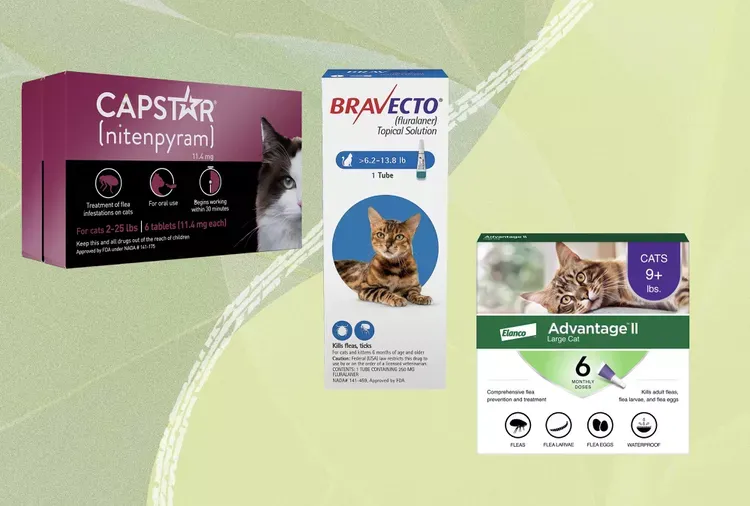
Fleas are one of those problems that looks small and then eats your whole month. One flea on the cat means dozens of eggs a day rolling off into your carpet, and by the time you’re actually seeing them jump you already have an infestation in the house, not just on the animal. I’ve been through this twice with my two indoor cats (fleas rode in on a foster dog once, and on a thrift-store cat tree the second time), and the thing nobody tells you up front is that the product you put on the cat is maybe a third of the job.
So this isn’t a list of five interchangeable topicals. It’s sorted by what you’re actually trying to do. Do you have fleas right now and need them dead today? Different answer than “my cat is fine and I want to keep it that way.” I’ll flag active ingredients on every pick, because that’s the one spec that actually separates these products, and I’ll be honest about which ones are worth the money and which are fine but overpriced.
One thing before anything else, because it’s the single most dangerous mistake people make: do not put a dog flea product on a cat. More on why below, but if you take nothing else from this page, take that.
Quick answer: what I’d reach for
- Best overall prevention: Revolution Plus (selamectin + sarolaner). A monthly vet topical that also covers ticks, ear mites, and some worms.
- Best OTC, no vet needed: Advantage II for Cats (imidacloprid + pyriproxyfen). Kills on contact and breaks the egg/larva cycle.
- Best for an active infestation, kills in hours: Capstar (nitenpyram). 99% of adult fleas dead in 3 to 6 hours, then follow with real prevention.
- Best long-duration, set-and-forget: Bravecto topical for cats (fluralaner). Up to 12 weeks per dose.
- Best collar: Seresto for Cats (imidacloprid + flumethrin). Up to 8 months from one collar.
- Best oral prevention: Comfortis (spinosad). A monthly chewable if your cat won’t tolerate topicals.
- For the house: an IGR home spray (pyriproxyfen or methoprene) plus a vacuum and hot water.
Everything here uses Amazon search links so you land on current listings and sizes rather than a dead product page. I earn a small commission if you buy through them, at no extra cost to you.
First, figure out which problem you have
This is where most flea guides go wrong. They hand you one monthly topical and call it done. But an active infestation and routine prevention are two different jobs.
If you have fleas right now (you’re seeing them, or your cat is scratching and you’re finding flea dirt), a monthly topical alone is too slow and doesn’t touch the eggs already in your carpet. You need a fast adult knockdown on the cat today, a real preventive started the same day, and the home treated in parallel. Skip any one of those three and the fleas come back.
If your cat is flea-free and you just want to keep it that way, you want steady monthly (or long-duration) prevention and you can ignore the fast-kill stuff. Pick a topical, a collar, or an oral and stay consistent year-round.
Knowing which camp you’re in changes every recommendation below.
Why the active ingredient is the only spec that matters
Brand names are marketing. The active ingredient is the actual drug, and it tells you what the product does and how fast. The shortlist worth knowing for cats:
- Selamectin (Revolution) and sarolaner (the “Plus” in Revolution Plus): monthly topical, broad coverage including mites and some worms.
- Fluralaner (Bravecto): topical that lasts up to 12 weeks instead of the usual month.
- Imidacloprid (Advantage, Seresto): kills fleas on contact, so they don’t have to bite first.
- Pyriproxyfen and methoprene: insect growth regulators (IGRs). These don’t kill adult fleas, they sterilize the life cycle by stopping eggs and larvae from developing. You want one of these in the mix, on the cat or in your home spray.
- Spinosad (Comfortis): a fast oral adulticide, monthly.
- Nitenpyram (Capstar): the fastest knockdown available OTC, but only works for about a day.
- Flumethrin (in Seresto): a pyrethroid, which is normally a red flag for cats, but the Seresto cat collar is specifically dosed and formulated for cats. Buy the cat version, never the dog one.
If two products share an active ingredient, you’re mostly paying for the brand and the applicator. That’s how you avoid overpaying.
Comparison table
| Product | Active ingredient | Type | Rx? | Duration | Kills eggs? | Age / weight minimum |
|---|---|---|---|---|---|---|
| Revolution Plus | Selamectin + sarolaner | Topical | Yes | ~1 month | Via cycle | 8 weeks / 2.8 lb |
| Bravecto (cat) | Fluralaner | Topical | Yes | Up to 12 weeks | No (adults) | 6 months |
| Advantage II | Imidacloprid + pyriproxyfen | Topical | No | ~1 month | Yes (IGR) | 8 weeks |
| Comfortis | Spinosad | Oral chewable | Yes | ~1 month | No | 14 weeks / 4.1 lb |
| Capstar | Nitenpyram | Oral tablet | No | ~24 hours | No | Check label |
| Seresto (cat) | Imidacloprid + flumethrin | Collar | No | Up to 8 months | Some | 10 weeks |
| Home spray | Pyriproxyfen / methoprene | Environment | No | Weeks to months | Yes | N/A |
Always confirm the exact age and weight cutoffs on the package you actually buy, because they vary by size and formulation.
The reviews
Revolution Plus (selamectin + sarolaner): best overall prevention
This is what I’d put on a healthy adult cat for year-round prevention, and it’s my top pick. It’s a monthly topical you squeeze onto the skin between the shoulder blades, and beyond fleas it covers ticks, ear mites, roundworms, hookworms, and heartworm. That breadth is the selling point: one dose handles most of what an indoor-outdoor cat runs into, so you’re not juggling three products.
It’s prescription, so you need a vet, and it’s not the cheapest option per dose. But the coverage justifies it, and the dosing is dialed in by weight. It’s labeled for kittens as young as 8 weeks and over 2.8 lb, which is younger than a lot of the alternatives.
Key features: selamectin + sarolaner, monthly topical, covers fleas, ticks, ear mites, and several worms, kitten-safe from 8 weeks / 2.8 lb, prescription required.
The honest downside is you’re paying vet-product prices for parasites your specific cat may never see. A strictly indoor cat with no dog in the house probably doesn’t need the tick and heartworm coverage. But if there’s any outdoor exposure, this is the one I trust most.
Check Revolution Plus for cats on Amazon
Bravecto topical for cats (fluralaner): best long-duration
If you hate the monthly reminder (and forget it, like I do), Bravecto is the answer. One topical dose of fluralaner protects against fleas and ticks for up to 12 weeks, so you’re dosing roughly four times a year instead of twelve. For a squirmy cat that turns application into a wrestling match, cutting the number of applications by two-thirds is a genuine quality-of-life upgrade for both of you.
It’s for cats 6 months and older, and there’s a Bravecto Plus version that adds moxidectin for broader parasite coverage if you want the worm and heartworm protection too. Prescription, again.
Key features: fluralaner, topical, up to 12 weeks per dose, fleas and ticks, cats 6 months+, Bravecto Plus adds moxidectin.
The tradeoff is the age floor (no young kittens) and the upfront cost of a dose that looks expensive until you remember it’s three months of coverage. It kills adult fleas rather than sterilizing eggs, so during an active infestation you still treat the home alongside it.
Check Bravecto for cats on Amazon
Advantage II for Cats (imidacloprid + pyriproxyfen): best OTC
If you don’t want to involve a vet, this is the one I’d grab. It’s been the over-the-counter benchmark for years, and it earns it. The imidacloprid kills fleas on contact, meaning they die from touching your cat’s coat rather than having to bite first, and the pyriproxyfen is an IGR that breaks the life cycle by stopping eggs and larvae from developing. That second part is why Advantage II punches above collar-only products during an actual infestation: it’s fighting on two fronts.
Monthly application, no prescription, and it’s labeled down to 8 weeks. For a healthy adult indoor cat, this is honestly all most people need.
Key features: imidacloprid + pyriproxyfen IGR, monthly topical, kills on contact plus breaks the egg/larva cycle, OTC, from 8 weeks.
It only handles fleas, not ticks or worms, so if you need broader coverage look at Revolution Plus instead. And like every topical, a small number of cats get mild irritation at the application spot.
Check Advantage II for Cats on Amazon
Capstar (nitenpyram): best fast knockdown for an active infestation
This is the fire extinguisher, not the smoke detector. Capstar is a cheap oral tablet of nitenpyram, and it is fast: it starts killing adult fleas within about 30 minutes and clears roughly 99% of them within 3 to 6 hours. If your cat came home crawling with fleas, this is what gives them relief the same afternoon.
But read this part carefully. It only works for about 24 hours, and it does absolutely nothing to eggs or larvae. It is not prevention. It’s a rescue dose you give while you get a real product and home treatment going. Give the Capstar, then that same day apply a monthly preventive and start on the environment.
Key features: nitenpyram, oral tablet, ~99% adult kill in 3 to 6 hours, ~24-hour window, OTC, kills adults only.
I keep a few tablets in the cabinet specifically for the “oh no, what is that jumping” moment. Used as a standalone it’s useless. Used as the first step of a real plan, it’s great.
Check Capstar for cats on Amazon
Comfortis (spinosad): best oral prevention
Some cats will not tolerate a topical. They lick at it, the fur mats, or you just can’t get a clean application on a cat who’s decided today is a fight. For those cats, Comfortis is a monthly chewable that skips the whole topical problem. The spinosad starts killing fleas within 30 minutes and clears about 98% of adults within 4 hours, which is unusually fast for a monthly product.
It’s prescription, labeled for cats 14 weeks and older and 4.1 lb and up.
Key features: spinosad, monthly oral chewable, ~98% adult kill within 4 hours, prescription, cats 14 weeks+ / 4.1 lb+.
Two caveats. It’s an adulticide, so no egg control, and you still handle the home during an infestation. And it has to actually go down and stay down, so if your cat is a champion pill-spitter, a topical or collar might be easier despite the mess.
Check Comfortis for cats on Amazon
Seresto for Cats (imidacloprid + flumethrin): best collar
The appeal of a collar is you put it on once and forget about it for months. Seresto is the one worth buying: up to 8 months of flea and tick protection from a single collar, and the EPA kept it registered after a well-publicized review, while requiring updated labeling. That’s a strong convenience-to-cost ratio if you have a cat who tolerates a collar.
The nuance that matters here. One of its two actives, flumethrin, is a pyrethroid, and pyrethroids are exactly the class that’s dangerous to cats in general. The cat version of Seresto is specifically dosed and formulated to be safe for cats. You must buy the cat-specific collar, never the dog one, and never assume “it’s Seresto, it’s fine.”
Key features: imidacloprid + flumethrin, collar, up to 8 months, fleas and ticks, OTC, cat-specific formulation.
Downsides: some cats hate wearing anything around the neck, and a collar protects the cat but does less for the environment than a contact-plus-IGR topical during a heavy infestation. Get one with a safety breakaway release so an outdoor cat can’t get hung up on it.
Check Seresto for Cats on Amazon
Read this before you touch anything: the dog-product warning
I’m giving this its own section because it kills cats every year.
Many dog flea products contain permethrin or other pyrethroids. In dogs, fine. In cats, these are highly toxic and potentially fatal, because cats lack the liver enzyme (they can’t efficiently glucuronidate them) to break the chemical down. A dose that’s routine for a dog can trigger violent tremors and seizures in a cat, and it can be fatal.
And it’s not just direct application. Cats have been poisoned simply by grooming or sleeping against a dog that was recently treated with a spot-on. So even if you’d never dream of putting the dog’s tube on the cat, keep a freshly treated dog away from your cat until the product has fully dried.
The rules that keep this from happening:
- Buy the cat-specific version of every product. If the box doesn’t clearly say it’s for cats, don’t use it.
- Never split or eyeball a dog dose “down” for a cat. It doesn’t work that way.
- Separate a just-treated dog from the cat until dry.
- If you think your cat contacted a pyrethroid, and especially if it’s twitching or drooling, that’s an emergency vet visit, not a wait-and-see.
Beyond pyrethroids, get a vet involved before treating any kitten under the product’s age minimum, senior cat, pregnant or nursing cat, or a cat that’s currently ill. Prescription products need a vet anyway, and the free advice on the tricky cats is worth the visit.
Best flea treatment for cats AND home: the part everyone skips
The fact that reframes the whole problem: roughly 95% of a flea infestation is not on your cat. The adults you see are maybe 5% of it. The rest is eggs, larvae, and pupae living in your carpet, your cat’s bedding, the cracks in the floor, and the baseboards.
The eggs are dust-sized white specks that roll off the cat wherever it goes. The larvae burrow down deep into carpet fibers and hide from light. The pupae are the real problem: they’re armored, most sprays can’t touch them, and they can sit dormant and keep hatching for weeks after you think you’ve won. That pupal window is exactly why infestations “come back” a week after you treated the cat. They didn’t come back. They were always in the floor.
So treating only the cat leaves the reservoir intact. What actually clears a home:
- Vacuum daily to every other day during an active infestation. Floors, carpets, upholstery, along the baseboards, under furniture. Vacuuming physically removes eggs and larvae, and the vibration and warmth actually coax pupae into hatching so your treatments can reach them. Empty the canister or bin outside afterward.
- Wash all pet bedding weekly in hot water. Anything the cat sleeps on. Hot, not warm.
- Use a home spray or fogger that contains an IGR (pyriproxyfen or methoprene). This is the key ingredient. Adulticide-only sprays kill what’s there today; the IGR stops the next generation from ever developing, which is what breaks the cycle. Treat the areas your cat frequents, not just the obvious middle of the room.
- For carpets and upholstery specifically, a deep clean helps physically flush out what’s buried in the fibers. A pet-focused carpet cleaner is a worthwhile companion to the spray.
Do the cat and the home on the same day. Treating one without the other is why people go three rounds with fleas over a summer.
A step-by-step plan to actually get rid of fleas
If you have an active infestation right now, do it in this order:
- Knock down the adults on the cat today. Give a nitenpyram tablet (Capstar) for relief within hours. If your cat’s up for a bath, a flea shampoo is a decent same-day extra knockdown step; see the cat shampoo guide for gentle options. Don’t rely on either one as your prevention.
- Start real prevention the same day. Apply a monthly topical (Advantage II or Revolution Plus), give an oral (Comfortis), or fit a collar (Seresto). This is what keeps new fleas from surviving on the cat going forward.
- Treat every pet in the house. Every cat, every dog, on their own species-appropriate product. One untreated animal keeps the whole thing alive.
- Hit the environment. Vacuum, hot-wash bedding, and apply an IGR home spray to the areas the cat uses. Deep-clean carpets and upholstery.
- Keep going for at least three months. Because of the pupal window and the sheer number of eggs already down, you have to outlast the reservoir. Keep everyone on prevention, keep vacuuming, keep washing bedding. Prevention should really be year-round after that, especially with any outdoor exposure.
The reason people fail is step 5. The cat stops scratching after a week and they quit, and the eggs in the carpet hatch right on schedule.
Why bother: what fleas actually do to a cat
If you’re tempted to skip prevention on an indoor cat, this is the motivation. Fleas aren’t just an itch.
- Flea allergy dermatitis (FAD) is a hypersensitivity to proteins in flea saliva. A single bite can set off intense itching, hair loss, and scabbing that lasts far longer than the bite. It’s one of the most common skin problems vets see in cats, and a cat recovering from it often benefits from skin and coat support.
- Tapeworms. Cats swallow fleas while grooming, and fleas carry tapeworm larvae. So a flea problem quietly becomes a worm problem.
- Anemia, especially in kittens and small cats. A heavy flea burden drinks enough blood to be genuinely dangerous to a small animal.
- Bartonella (cat-scratch disease), which fleas can carry and which matters for the humans in the house too.
That’s the case for prevention being cheaper and easier than treatment, every time.
A realistic word on natural options
I get the appeal, and I’m not going to tell you flea combs are useless. Regular grooming with a fine flea comb genuinely helps you catch a problem early and physically removes some fleas and flea dirt, and daily vacuuming is one of the most effective non-chemical tools you have. A good comb and grooming routine earns its place in the plan.
But be clear-eyed about what “natural” products can and can’t do. Plant-oil sprays and diatomaceous earth are lower-efficacy and shorter-lived than EPA and FDA regulated actives, and they will not clear a real infestation on their own. And the safety framing is backwards: some essential oils are themselves toxic to cats, so “natural” absolutely does not mean “safe for cats.” Tea tree oil is a classic example. Use grooming and cleaning as support around a regulated product, not as a replacement for one.
How to choose, quickly
- Active infestation, need results today: Capstar now, then a monthly product and the home plan.
- Healthy adult, want simple year-round prevention, no vet: Advantage II.
- Want the broadest coverage and don’t mind a vet: Revolution Plus.
- Forget monthly doses: Bravecto, up to 12 weeks.
- Cat won’t tolerate topicals: Comfortis oral, or a Seresto collar.
- Multi-pet household: put every animal on its own species-correct product, same week.
- Kitten, senior, pregnant, nursing, or sick cat: talk to a vet before anything.
There is no universal best. Match the product to your cat’s age, weight, health, and lifestyle, and to whether you’re fighting fleas or preventing them. When in doubt, the vet visit is cheap insurance.
Related reading
- Best tick treatments for cats: if your cat also faces ticks, many of these products cover both, so match them up here.
- Best cat shampoos: flea shampoos and gentle bathing as a same-day knockdown step.
- Best carpet cleaners for pet homes: for the eggs and larvae hiding in carpets and upholstery.
- Best cat brushes and flea combs: for catching fleas and flea dirt early.
- Best cat ear cleaners: ear mites often ride along with fleas, and broad-spectrum topicals cover both.
- Best cat supplements: skin, coat, and immune support to help a cat recover from flea allergy dermatitis.
- Best air purifiers for pet homes: for cutting dander and allergens while you’re deep-cleaning a flea-hit house.