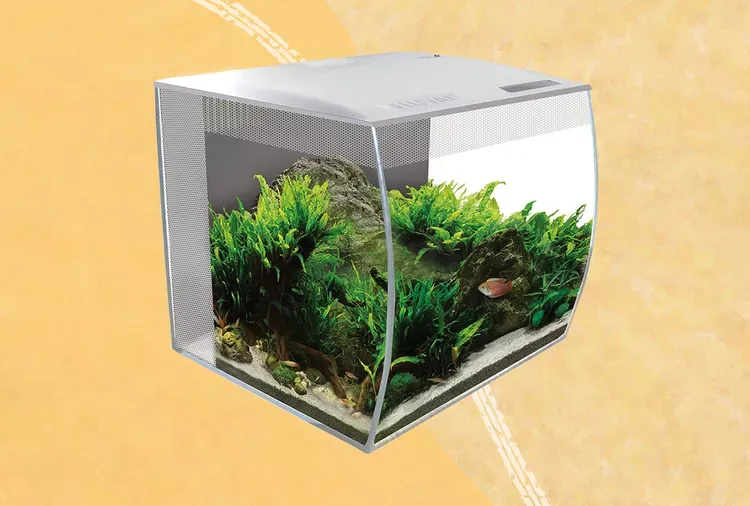
Small tanks have a reputation for being the easy, beginner-friendly option. That reputation is backwards. Less water means temperature and water chemistry move faster, so a small tank punishes a skipped water change or a dead heater harder than a 40-gallon would. That’s the one thing I wish someone had told me before my first 5-gallon.
None of that means you should avoid a small aquarium. A well-chosen 5-gallon on a desk is one of the nicest things you can own, and a single betta in a planted nano is calming to sit next to. You just need to go in knowing what the kit includes and which fish actually belong in that much water.
I’ve kept bettas and shrimp in tanks this size for years, and below are the four kits I’d actually recommend, plus a few worth searching for if you want more options. I’ve listed the real cons too, because every one of these has at least one.
Quick answer: the best small fish tanks in 2026
- Best overall: Fluval Spec V (5 gallon). Rimless glass, hidden 3-stage filtration, a real plant-capable light. No heater though.
- Best for bettas: Fluval Betta Premium Kit. Gentle flow designed around long fins, heater included.
- Best budget: Marina 5 Gallon LED Kit. Cheap, hooded, gets you running for the least money.
- Best for a design piece: Fluval Edge. The enclosed top-viewing cube. Beautiful, a bit fussy to maintain.
If you want the short version: get the Fluval Spec V, buy a 25 to 50W adjustable heater separately, and you’ve got a setup that’ll last for years.
How small is too small? (the “smallest fish tank” question)
People search for the smallest fish tank all the time, usually hoping to squeeze a betta onto a narrow shelf. Here’s how I think about it.
For a single betta, 2.5 gallons is the practical floor. Below that, the water volume is so small that a warm afternoon or a couple of days of skipped maintenance can move your parameters into dangerous territory before you notice. Those 1-gallon “betta bowls” and cube desk toys look cute and they sell well, but they’re the hardest tanks in the hobby to keep alive, not the easiest.
Five gallons is where I tell everyone to start. It’s still small and it still fits on a desk, but you get enough water that temperature holds steady overnight and your beneficial bacteria have room to buffer the daily waste. More water is more forgiving. That’s the whole rule.
If you’re weighing this against going a size bigger, my beginners fish tank guide compares kits across the full range of sizes and budgets, and a 10-gallon is easier to keep than a 3-gallon if you have the space.
What to look for in a small aquarium
The kits below look similar in photos and behave very differently in your living room. These are the things that actually separate them.
Is a filter included, and how strong is it? Most kits include one. The catch is flow. A small tank needs gentle filtration, an internal, a sponge, or a baffled hang-on-back unit. A pump rated far above your tank’s volume turns a 5-gallon into a washing machine, which stresses bettas and blows shrimp around. Gentle beats powerful here. If you want to compare filter types properly, I go deeper in the aquarium filtration guide.
Is a heater included? Usually not, and this is the number one thing new owners miss. Tropical fish and bettas want a stable 78 to 82F. Budget for a heater from the start. Sizing is roughly 5 watts per gallon, so a 5-gallon wants a 25 to 50W adjustable model. Cheap nano heaters are notoriously flaky, and in this little water a stuck heater cooks fish fast, so this is one place not to buy the cheapest thing. See the submersible heater roundup for models that hold temperature.
What kind of light? A basic hood light shows your fish. A plant-capable LED lets you actually grow things, which is what makes a small tank look good and stay stable. If live plants are the plan, the planted-tank LED guide covers upgrades, and low-light species from the easy aquarium plants list are the ones that thrive in this size.
Glass or acrylic? Glass is heavier, scratches less, and stays clearer over years. Acrylic is lighter and won’t shatter, but it scuffs if you look at it wrong. For a tank you’ll clean weekly, glass usually wins.
Rimless or hooded? Rimless open-top tanks (like the Spec) look modern and light plants better, but they evaporate faster and a jumpy fish can leap out. Hooded kits (like the Marina) are cheaper, hold humidity, and keep fish in. Bettas especially are jumpers, so a lid matters.
Small fish tank comparison table
| Tank | Capacity | Footprint | Filter included | Heater included | Light | Best for |
|---|---|---|---|---|---|---|
| Fluval Spec V | 5 gal | ~14 x 10 x 14.5 in | Yes, 3-stage back chamber | No | Plant-capable LED | Nano fish, shrimp, planted |
| Fluval Betta Premium | 2.6 to 6 gal | Compact, model-dependent | Yes, gentle flow | Yes | LED | A single betta |
| Marina 5 Gallon LED | 5 gal | ~15 x 9 x 10.75 in | Yes, internal | No | Basic hood LED | Cheapest way to start |
| Fluval Edge | 6 or 12 gal | Enclosed cube | Yes, hidden | No | LED (enclosed) | A display centerpiece |
Footprints are approximate and vary by production run, so double-check before you buy a stand or clear shelf space.
The reviews
Fluval Spec V (5 gallon): best overall
This is the one I keep coming back to. Five gallons of rimless glass with the entire filter hidden in a chamber behind the back wall, so the display is clean and there’s no ugly box hanging off the side. The 3-stage filtration (mechanical, chemical, biological) does a solid job for the size, and the included LED is bright enough to grow low-light plants, which most stock kit lights can’t manage.
The honest downside is flow. Even on its lowest setting the return pump pushes more current than a betta or shrimp wants, and this is a well-known Spec complaint, not just my tank. The fix is easy and cheap: wedge a small piece of filter sponge over the outflow, or clip on a pre-made baffle, and the current softens right down. The other thing to remember is there’s no heater in the box, so add a 25 to 50W adjustable one. Do those two things and it’s hard to beat.
Key features: 5 gal rimless glass, hidden 3-stage filtration, plant-capable LED, honeycomb baffle in the back chamber. No heater.
Fluval Betta Premium Kit: best for a betta
If you specifically want a betta and nothing else, this is the simplest path. Unlike most small kits, it ships with a heater, and the filter is tuned for gentle output so it won’t shred long fins or push your fish around the tank. It comes in a few sizes (roughly 2.6 to 6 gallons depending on model), and I’d steer you to the largest one you have room for, since more water is easier on both you and the fish.
It’s not the tank I’d pick if you ever want to keep shrimp or a nano school, because it’s built narrowly around betta care and the smaller versions are, well, small. The included light is fine for viewing but won’t grow demanding plants. For what it is, though, a warm, calm, betta-appropriate box out of one purchase, it does the job and skips the “wait, I need to buy a heater too” surprise.
Key features: heater included, gentle betta-safe flow, multiple size options, starter substrate and conditioner in the box.
Marina 5 Gallon LED Kit: best budget
When someone wants to try fishkeeping without spending much, this is what I point them at. It’s a straightforward hooded 5-gallon with an internal filter and a basic LED, and it usually costs a good bit less than the Fluval kits. The hood is actually a plus for beginners: it keeps evaporation down and stops a betta from jumping out, which the open-top rimless tanks don’t.
You get what you pay for on the details. The light is view-only, so demanding plants won’t grow under it, and like the others there’s no heater included. The internal filter works but isn’t as tidy or as quiet as the Spec’s hidden chamber. None of that matters much if your goal is a solid, cheap first tank for a betta or a few shrimp. It’ll do that for years.
Key features: 5 gal with hood, internal filter, basic LED, low entry price. No heater, view-only light.
Fluval Edge: best as a display piece
The Edge is the one people stop and stare at. It’s an enclosed cube with a small top opening and a mostly closed top, so you view the fish through the front glass with the water line hidden. It comes in 6 and 12 gallon versions, the filtration is tucked away, and lit up on a shelf it looks like a piece of furniture.
That closed-top design is also its catch. Getting your hands inside to plant, scrape algae, or catch a fish is fiddly through the small opening, and the enclosed shape traps gas exchange more than an open tank, so it wants a bit more attention to stay healthy. I’d call this an intermediate tank dressed up as a beginner one. If you love the look and don’t mind the extra maintenance quirks, get the 12-gallon over the 6, and no heater is included here either.
Key features: enclosed top-viewing cube, hidden filtration, striking LED-lit display, 6 or 12 gal. Harder to service, no heater.
A few more worth searching for
The four above are the ones I’d personally buy, but the small-tank market has good options I can’t link directly. If you want to broaden the search:
- Marineland Portrait 5 gallon, a tall glass tank with hidden 3-stage filtration and a day/night LED. A close competitor to the Spec if you prefer the vertical shape.
- Aqueon MiniBow 5 gallon with SmartClean, a curved-front budget kit with a quick water-change feature that beginners like.
- Fluval Flex 9 gallon, a curved-front tank with the same back-chamber filtration as the Spec if you want to step up a couple of gallons.
- NICREW nano rimless kits, inexpensive rimless glass for aquascapers who want to pick their own filter and heater.
Stocking a small tank without overcrowding it
This is where most small tanks go wrong. The water looks empty so the temptation is to keep adding fish, and a 5-gallon fills its waste budget fast. Pick one of these directions and stop there:
- A single betta. The classic small-tank fish. Give it the whole tank, some plants, and calm water.
- A nano school. Ember tetras, chili rasboras, or celestial pearl danios in a group of six or so. Tiny, peaceful, low waste.
- Shrimp and snails. A cherry shrimp colony with a nerite snail or two is my favorite low-maintenance option, and they’re endlessly interesting to watch.
What doesn’t belong in a small tank: goldfish (they’re messy and grow big), any active or large fish, and a betta crammed in with a school. Bettas want the tank to themselves. If you plan to plant it, the low-light species in the easy plants guide are the ones that survive in this little light and water.
Cycle it before the fish go in
Small tanks are more volatile, which means new tank syndrome, the ammonia and nitrite spike a fresh tank goes through, hits harder here than in a big one. Adding fish to an uncycled 5-gallon is the single most common way beginners lose their first fish.
Do a fishless cycle first. It takes roughly four to six weeks to build up the beneficial bacteria that process waste, and there’s no shortcut worth the risk. My complete guide to aquarium cycling walks through every step. While you’re cycling and afterward, you’ll want to test your water parameters with a proper liquid kit, since the strips lie and small tanks give you no room to guess.
A note on bettas and gentle flow
If you’re keeping a betta, current is your enemy. Those long fins act like sails, and a filter that’s too strong leaves a betta pinned in a corner or constantly fighting the flow, which wears it out. Every strong-flow kit (the Spec included) benefits from a baffle: a piece of sponge over the outflow, or a DIY water-bottle deflector, both work. Some keepers also prefer running gentle aeration instead of a strong filter, and the betta air pump guide covers quiet options that oxygenate without making waves.
Freshwater vs nano-reef, quickly
If you searched for a “nano aquarium” hoping to keep coral and clownfish, know that nano-reef saltwater is a different and more demanding hobby than everything above. It needs salt mixing, more precise lighting, and tighter parameter control, and I’d never recommend it as a first tank. Everything on this page is freshwater. Start here, get comfortable, and the reef will still be there in a year.
Frequently asked questions
What is the smallest fish tank you can actually keep fish in?
For a single betta, 2.5 gallons is the practical floor, and 5 gallons is the size I recommend to almost everyone. Anything smaller swings in temperature and water chemistry far faster, so the tiny 1-gallon and “betta cube” tanks are harder to keep stable, not easier. Small water volumes punish mistakes quickly, so more water gives you a bigger margin for error.
What is the best small fish tank with a filter included?
The Fluval Spec V (5 gallons) and Marina 5 Gallon LED both include filtration out of the box, and the Fluval Betta Premium kit adds a gentle filter tuned for long-finned fish. Most kits include a filter, but check the flow rate. For a small tank you want a gentle internal, sponge, or baffled hang-on-back filter, not a pump rated far above the tank’s volume.
Do small fish tanks come with a heater?
Usually not. Most small kits, including the Fluval Spec and Marina, ship without a heater, which trips up a lot of first-timers. Tropical fish and bettas need a stable 78 to 82F, so budget for a 25 to 50W adjustable nano heater on top of the tank. The rule of thumb is roughly 5 watts per gallon.
What is the difference between a mini aquarium and a nano aquarium?
In practice the terms overlap. “Mini” or “small” usually means a 2.5 to 10 gallon freshwater desktop tank. “Nano” is used the same way for freshwater but also refers to nano-reef saltwater tanks under about 20 gallons, which are a different, more demanding hobby. This guide is freshwater-focused.
How many fish can I keep in a 5 gallon tank?
One betta, OR a small nano-fish group like ember tetras, chili rasboras, or celestial pearl danios, OR a shrimp and snail colony. Pick one of those, not all three. Small tanks are less forgiving of waste, so overstocking (“just one more fish”) is the fastest way to crash your water. Active fish and goldfish are a hard no in this size.
How often should I clean a small fish tank?
A 25 to 30 percent water change weekly, since waste concentrates faster in less water. Vacuum the substrate, wipe the glass, and rinse filter media in old tank water (never tap water) roughly monthly. Skip full water changes, which wipe out the beneficial bacteria your fish depend on.
The verdict
For most people the Fluval Spec V is the small tank to buy: good glass, hidden filtration, a light that grows plants, and a flow problem that a scrap of sponge fixes in thirty seconds. Add a decent 25 to 50W heater and you’re set. If it’s strictly a betta, the Fluval Betta Premium kit saves you the heater trip. If money is tight, the Marina 5 Gallon does the job for less. And if you want something that turns heads more than it grows plants, the Fluval Edge is the display piece, as long as you accept the extra maintenance.
Whichever you pick, the tank is the easy part. Buy a heater and cycle the water fully before the fish go in, then resist the urge to overstock. Do that and a small aquarium will run happily for years.
Related reading
- Best fish tanks for beginners. Comparing sizes and budgets across the full range.
- Complete guide to aquarium cycling and the nitrogen cycle. Do this before adding fish.
- Best submersible aquarium heaters. Picking a reliable 25 to 50W nano heater.
- Best aquarium water test kits. Because small tanks give you no room to guess.
- Best filtration systems for aquariums. Comparing filter types for small tanks.
- Best air pumps for betta fish. Gentle aeration for low-flow setups.
- Best LED lights for planted tanks. If you want live plants to actually grow.
- Best low-light aquarium plants. The species that thrive in small, dim tanks.